
Polarity Therapy
Offering:
Energy-Based Bodywork for Embodied Vitality
Flow & Balance in the play of opposites:
Polarity Therapy
Technique Overview
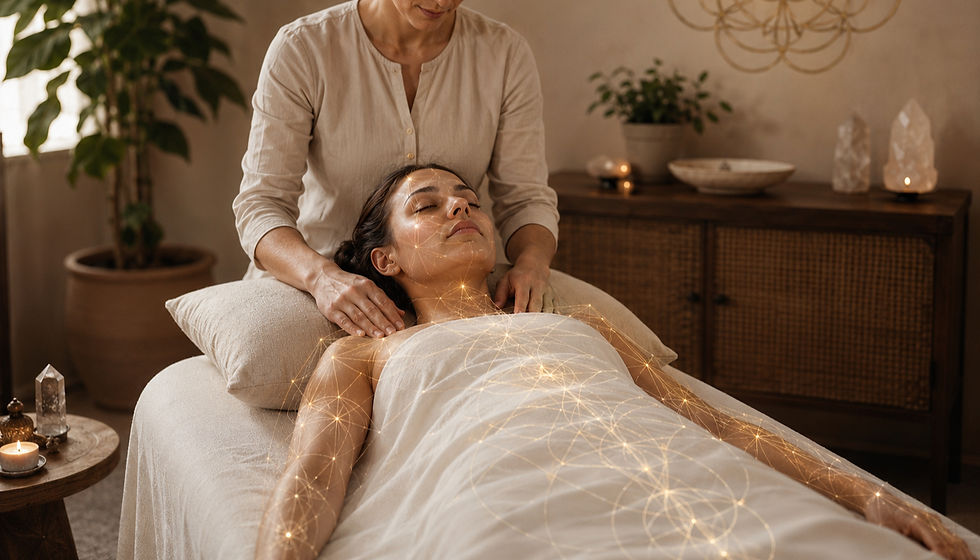
Polarity Therapy is based on the understanding that the body is organized through living currents of energy, movement, and relationship. Rather than treating the body as a collection of separate parts, this work listens for how the whole system is communicating — where energy feels open or restricted, where the body is giving too much or just depleted, and where balance may be seeking to restore itself.
Polarity techniques will include:
-
gentle touch,
-
still holds,
-
subtle rocking,
-
light compression,
-
stretching,
-
or contact between two or more areas of the body.
These contacts are often used to support relationship across the body's energetic electromagnetic system — such as head and feet, left and right, upper and lower body, center and periphery, or areas that feel charged, stagnant, or disconnected. In this way, the work helps the body notice its own patterns and invites more coherency in the flow of energy, sensation, breath, and awareness.
The philosophy of Polarity Therapy is a synthesis of Western Medicine with Eastern Healing Practices and was the developed by Dr. Randolph Stone - an osteopath, chiropractor, naturopathic doctor, midwife, and homeopath. Polarity Therapy was his life's work. He recognized that health is supported by the dynamic flow between opposites:
-
movement and stillness,
-
expansion and contraction,
-
giving and receiving,
-
grounding and uplift.
When these natural polarities become strained by stress, injury, emotion, or long-held protective patterns, the body may feel tense, scattered, heavy, fatigued, or out of sync. Through gentle contact and attentive presence, the practitioner supports the system in returning to a more balanced relationship with itself.
My approach with Polarity Therapy is quiet, responsive, and non-forceful. I may use verbal check-ins or somatic guidance to help you notice sensations, emotions, breath, temperature, images, or subtle shifts as they arise. The goal is not to force release, but to create enough safety, awareness, and energetic support for the body to soften, reorganize, and reconnect with its own vitality at a pace that honors your comfort, boundaries, and inner authority.
In the words of Dr. Stone, "Running water clears itself."
What This Work Supports
What Sets This Work Apart
Polarity Therapy stands apart because it bridges bodywork and subtle energy awareness. It is physical enough to feel grounding, while spacious enough to address patterns that may not present as a single ache, injury, or symptom.
Rather than relying on pressure or intensity, Polarity Therapy works through pulsation, relationship, rhythm, and receptivity. A session may feel quiet on the surface, but the practitioner is listening for how energy, sensation, breath, emotion, and physical structure are participating in one larger pattern.
This work can be especially meaningful for people who sense that their discomfort is not only muscular or mechanical. As one of my teachers - John Chitty - often said, “There is no such thing as a purely physical condition.” Polarity Therapy can meet us in places where we feel scattered, heavy, guarded, depleted, or difficult to name without reducing the experience to a pathology.
Over time, clients may notice more groundedness, easier breathing, softer tension patterns, improved rest, and a clearer sense of connection to themselves. These shifts can support greater vitality, emotional steadiness, mental clarity, and a more integrated sense of flow in daily life.
Frequently Asked Questions
... About Polarity Therapy
Why is it called Polarity Therapy?
It is called Polarity Therapy because the work is based on the relationship between energetic opposites — positive, negative, and neutral; upper and lower body; left and right; movement and stillness; effort and rest. Health is supported when these natural polarities can relate, communicate, and return to a more balanced flow.
What does “energy flow” mean?
In Polarity Therapy, “energy flow” refers to the felt movement of vitality through the body — expressed through breath, sensation, warmth, spaciousness, grounding, emotion, and aliveness. When this flow feels blocked, scattered, depleted, or held, the body may feel tense, heavy, tired, or out of sync.
If the touch is gentle, can it really have that much of an effect?
Gentle touch can create deep change because the body does not have to brace against force. When the system feels safe, met, and unpressured, protective patterns may soften and the body can begin to reorganize at its own pace - a pace which proves m
I've tried Reiki before... Is this like Reiki?
No. Polarity Therapy is not Reiki.
While both approaches may include subtle energy awareness, Polarity Therapy is a distinct system of bodywork with its own philosophy, techniques, and way of understanding the body. Reiki is generally centered on the transmission or channeling of universal life energy, often through still hand placements.
Polarity Therapy is more body-based and relational. It works with touch, holds, gentle movement, rocking, light compression, stretching, and contact between different areas of the body to support balance, flow, and integration.
So while people who enjoy Reiki may also appreciate Polarity Therapy, they are not the same practice. Polarity Therapy bridges energy awareness with hands-on bodywork, somatic listening, and the dynamic balance of opposites in the body.
Is Polarity Therapy more calming or energizing?
It can be both. Where the system is overactive or overwhelmed, Polarity Therapy may feel calming and settling; where the body feels depleted or stagnant, it may help restore a sense of movement, vitality, and gentle aliveness. Everyone responds differently, and at different times. That is, you might have a an energizing session one day and a more calm session the next.